
The Real Beacon Hill: Exploring the Setting of The Bachelor Sage
Explore one of the oldest neighborhoods in America
William Charles
10/30/20255 min read
A World of Marble and Secrets
Close your eyes and picture Beacon Hill in 1912.
Gas lamps flicker against brick facades. Cobblestone streets echo with the clip-clop of horses and the occasional rumble of an early automobile. Behind tall windows with heavy drapes, Boston's elite gather in parlors filled with oil paintings, Persian rugs, and the weight of old money.
This is the world Edward Sage was born into. The world that cast him out at eighteen. And the world that—twenty years later—drags him back.
The Bachelor Sage is set in a very real place, among very real institutions that still exist today. Let me take you on a tour of 1912 Boston, where every marble step and mahogany door tells a story of power, exclusivity, and the suffocating price of belonging.
Sage Manor: Chestnut Street
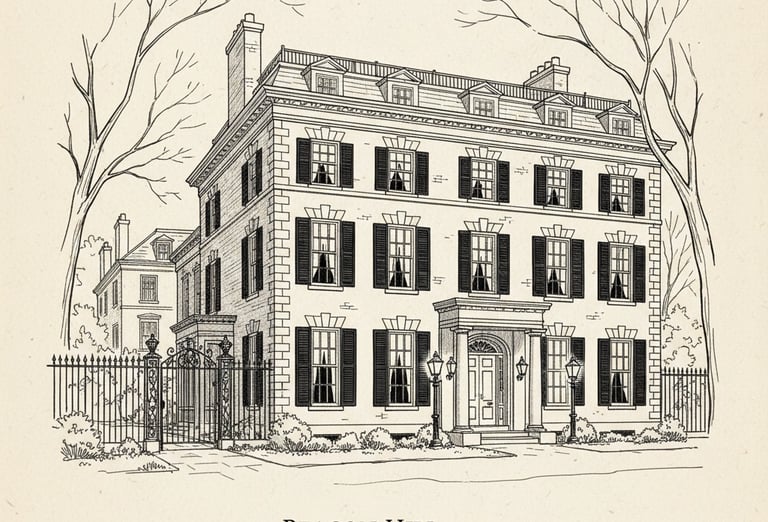
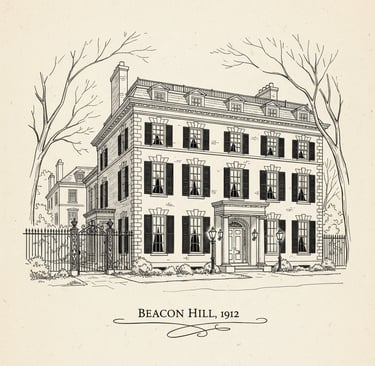
In the heart of Beacon Hill, on one of its most prestigious streets, stands Sage Manor.
Chestnut Street in 1912 was—and remains—one of the most elegant addresses in Boston. Lined with Federal and Greek Revival townhouses, it was home to the city's oldest families, the ones whose wealth dated back generations, whose names appeared in social registers and on corporate boards.
But Sage Manor isn't just another Beacon Hill townhouse.
It's a palatial four-story home on a rare double lot—a statement of power in a neighborhood where space is the ultimate luxury. In crowded urban Beacon Hill, where homes are packed shoulder-to-shoulder along narrow streets, a double lot is extraordinary. It says: We have more than you. We always have.
The house boasts a side garden—private, enclosed, a rare patch of green in the city. A place for secrets. A place where conversations and a a first kiss can happen under the moonlight of a star-filled night sky.
Inside, Sage Manor is all marble halls and grand staircases, oil portraits of ancestors staring down from the walls, rooms designed to impress and intimidate. It is Harrison Sage's kingdom—cold, controlled, meticulously curated. Every detail reflects his obsession with appearances, with legacy, with power.
For Edward, returning to Sage Manor after twenty years is like walking back into a mausoleum. Beautiful. Suffocating. Haunted.
The Parker House: Where Boston's Elite Dined
If you wanted to see and be seen in 1912 Boston, you went to the Parker House.
Opened in 1855, the Parker House Hotel (now the Omni Parker House) at 60 School Street was the crown jewel of Boston hospitality. It was where politicians brokered deals, where literary figures gathered, where the city's elite celebrated engagements and conducted business over oysters and champagne.
The Parker House was famous for its opulence—crystal chandeliers, white-gloved service, a dining room that glittered with silverware and status. It was also the birthplace of Boston Cream Pie and Parker House Rolls, culinary icons that remain famous today.
But more than the food, the Parker House was about exclusivity. It was a place where you went to remind everyone of your place in the social hierarchy. Where you wore your finest, smiled your brightest, and performed your respectability.
In The Bachelor Sage, the Parker House represents everything Edward fled. The performance. The scrutiny. The exhausting theater of Boston society, where every meal is a test and every conversation a potential trap.
The Somerset Club: The Inner Sanctum
If the Parker House was where Boston's elite were seen, the Somerset Club was where they truly belonged.
Founded in 1851 and still operating today at 42 Beacon Street, the Somerset Club is one of the oldest and most exclusive private clubs in America. Membership was—and remains—highly restricted. In 1912, it was the domain of wealthy, white, Protestant men. Old money. The right families. The right schools.
The Somerset Club wasn't just a social club. It was a fortress of power. Deals were made there. Alliances formed. Reputations built or destroyed over cigars and brandy in rooms lined with dark wood and leather.
For men like Harrison Sage, membership in the Somerset Club was proof of arrival, of legitimacy, of unassailable status. It was the inner sanctum—the place where Boston's elite decided who mattered and who didn't.
For Edward, it represents everything he was denied. The world that rejected him. The gatekeepers who decided he wasn't worthy. The suffocating exclusivity that demanded conformity at any cost.
Beacon Hill Then and Now
Here's the remarkable thing about Beacon Hill: It hasn't changed much.
Walk down Chestnut Street today, and you'll see the same brick townhouses, the same gas lamps (now electric, but styled to look original), the same narrow sidewalks and cobblestones. Beacon Hill is a living museum, meticulously preserved by residents who value history and exclusivity in equal measure.
The Parker House still operates as a hotel. You can still order Boston Cream Pie in the same dining room where Boston's elite gathered over a century ago.
The Somerset Club still stands at 42 Beacon Street, still exclusive, still private, still a symbol of old money and gatekeeping.
In many ways, the world of The Bachelor Sage is still here. You can walk through it. Touch the same iron railings. Climb the same marble steps.
But some things have changed.
The rigid social hierarchies of 1912 have softened (though not disappeared). The overt exclusions based on religion, ethnicity, and class are less explicit (though still present in subtler forms). And LGBTQ+ people—who in 1912 were criminalized, erased, forced into exile—can now walk these streets openly.
But the tension between belonging and authenticity? Between acceptance and freedom? That hasn't changed at all.
Why This Setting Matters
The Bachelor Sage could have been set anywhere. But it had to be Boston. And not just because I happen to live here.
Because Boston in 1912 represents a very specific kind of oppression: the kind wrapped in marble and manners. The kind that smiles while it destroys you. The kind that says, You can belong here—as long as you pretend to be someone else.
Beacon Hill isn't just a setting. It's a character. It's the weight of legacy, the suffocation of expectation, the beauty that hides cruelty. It's every gilded cage that promises safety in exchange for your soul.
Edward spent twenty years in Paris—a city that let him breathe, even if it never truly set him free. But Boston? Boston is where he has to decide: Will he perform respectability one more time? Or will he finally choose authenticity, no matter the cost?
Walk With Me
If you ever find yourself in Boston, take a walk through Beacon Hill.
Start at the corner of Chestnut Street and imagine Sage Manor—four stories of brick and secrets, a double lot that whispers power, a side garden where truths are spoken in hushed voices.
Walk down to Beacon Street and stand outside the Somerset Club. Picture the men in tailcoats and top hats, the gatekeepers who decided Edward Sage didn't belong.
Stop by the Omni Parker House on School Street. Order a slice of Boston Cream Pie and imagine the glittering dining room in 1912, full of people performing their lives for an audience that never stops watching.
And as you walk these streets—still beautiful, still exclusive, still haunted by history—ask yourself:
What does it cost to belong? And is it ever worth the price?
Contact
Newsletter
william@williamcharlesauthor.com
© 2024. All rights reserved.
Follow me!