
Character Spotlight: Edward Sage - A Man Out of Time
Edward Sage has spent two decades crafting his exile in Paris, France - a glittering world of champagne, artistic salons, and curated pleasures, far from his father's suffocating control and Boston's rigid expectations. But when tragedy strikes, his world crumbles, forcing him back to the very world he fled.
William Charles
10/28/20254 min read
The Man in Exile
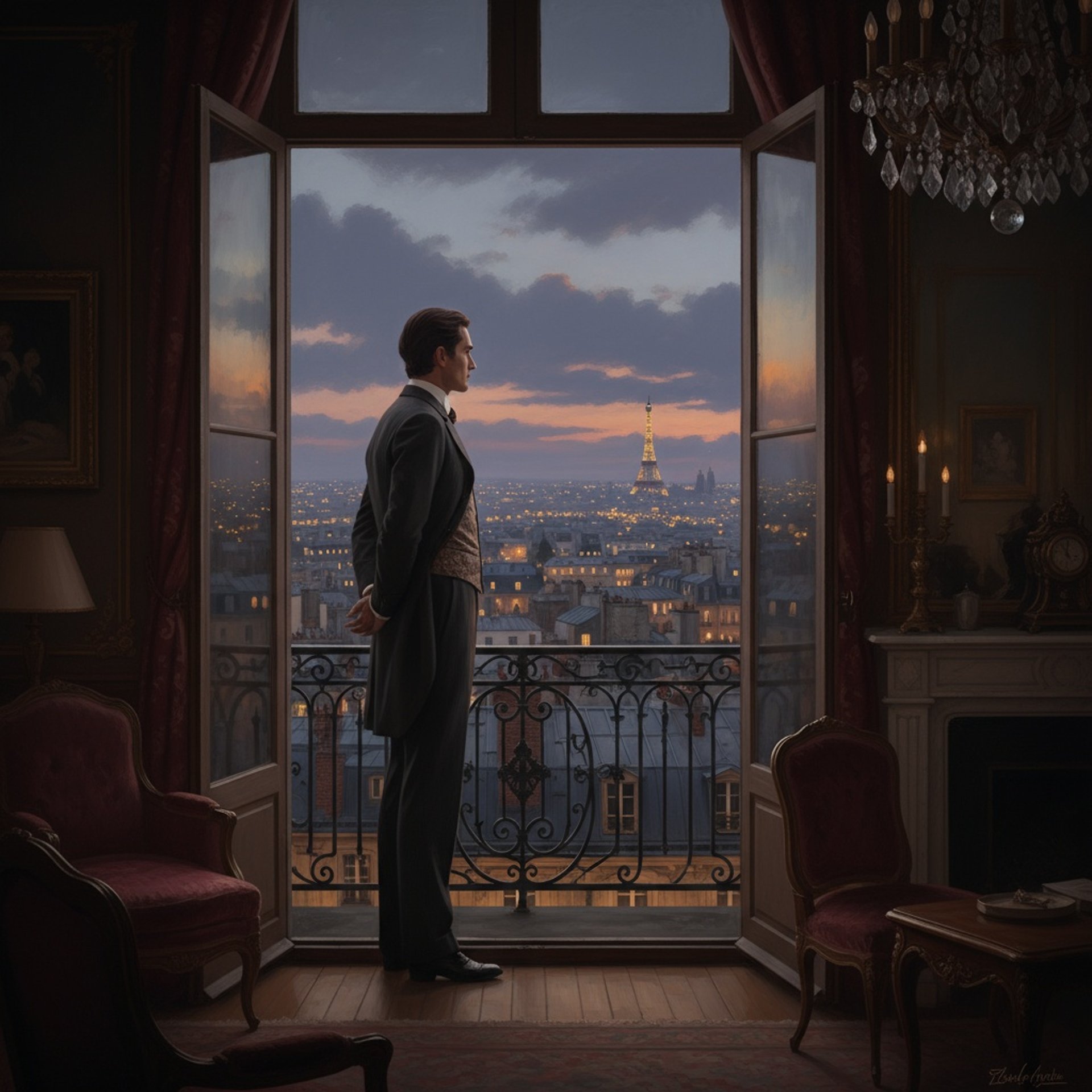
Picture a man standing on a Parisian balcony at twilight, gazing out over Montparnasse as the city lights flicker to life. He is elegant, composed, surrounded by beauty. To the casual observer, he is the portrait of freedom—a man who has built a life on his own terms, far from the constraints of his past.
But look closer. In the shadows of that opulent salon behind him, in the careful way he holds himself, in the practiced ease of his smile—there is something else. A question that has haunted him for twenty years:
Was he ever truly free? Or was exile just another cage?
This is Edward Sage. And his story is about to change everything.
The Banishment
Edward was eighteen years old when his father cast him out of Sage Manor.
Eighteen. On his birthday.
There had been a scandal—something unforgivable in the eyes of Boston's elite, something that shattered the carefully constructed facade of the Sage family. The details don't matter as much as what happened next: Harrison Sage, cold and unyielding, banished his son. Not with regret. Not with hesitation. With finality.
Edward was given no choice in his exile. But he was given one decision: where to go.
He chose Paris. A city that promised acceptance. A place where men like him could exist without apology, where art and beauty mattered more than bloodlines and expectations. A place that whispered: Here, you can be free.
For twenty years, Edward believed it.
The Gilded Cage
What does freedom look like when it's built on the rubble of rejection?
For Edward, it looked like champagne and candlelight. Endless parties in perfumed salons. Beautiful people who drifted in and out of his life like smoke. Laughter that filled the silence but never quite reached the depths.
He collected acquaintances the way others collect art—carefully, aesthetically, but never letting them too close. No one offered him anything meaningful. No one asked what lay beneath the surface. And Edward? He made sure they never had to.
Because beneath the glittering veneer was pain. Raw, unresolved, carefully buried for two decades. Pain from a father who chose cruelty over love. Pain from a world that demanded he disappear. Pain from the knowledge that exile—no matter how beautiful—is still exile.
Edward numbed it with distraction. He built a life that looked like freedom but felt like survival.
And then, in the spring of 1912, everything changed.
The Return
Spring. The season of renewal, of rebirth, of new beginnings. In Paris, the trees bloomed, the air warmed, and Edward allowed himself to believe—just for a moment—that change might finally bring something good.
1912 delivered change, all right. Just not the kind he expected.
Tragedy strikes. The kind that shatters worlds and demands reckoning. Edward is dragged back to Boston, back to Sage Manor, back to the marble halls and suffocating expectations he spent twenty years trying to forget.
Back to his father.
The world that rejected him now demands his presence. The family that cast him out now needs him. And Edward—artistic, guarded, scarred—must return to the very place that taught him he could never be enough.
But this time, he's not the eighteen-year-old boy who was banished on his birthday. He's a man who has lived, who has survived, who has spent two decades asking himself what freedom really means.
The question is: Will he find the courage to live authentically? Or will he repeat the cycle, burying his truth beneath duty and expectation once again?
A Man Out of Time
Edward Sage is a man caught between worlds.
He is more comfortable with servants than with Boston's elite—a telling detail that speaks to his rejection of the class system that rejected him. He is artistic in a world that values commerce and conformity. He is traumatized by parental neglect and cruelty, yet still shaped by the family that cast him out.
He is a survivor. But surviving is not the same as living.
In 1912, men like Edward were expected to disappear. To marry women they didn't love, to bury their desires, to perform respectability until it killed them—or they killed themselves. Some did. Some lived double lives, forever looking over their shoulders. Some, like Edward, chose exile.
But exile is not freedom. It's just distance.
Edward's journey is about confronting that truth. About asking whether authenticity is possible in a world designed to crush it. About deciding whether the cost of living honestly is worth paying—or if the price is simply too steep.
Why Edward's Story Matters Today
Edward's story is set in 1912, but his struggle is timeless.
How many of us have asked ourselves: Can I be free, or just tolerated?
How many of us have built lives that look like freedom but feel like survival?
How many of us have buried pain beneath distraction, collected people and things without connection, smiled through the loneliness because it seemed easier than confronting the truth?
Edward is a mirror. For LGBTQ+ people, yes—but also for anyone who has ever felt the tension between who they are and who the world expects them to be. Between authenticity and acceptance. Between living and merely surviving.
His story matters because we are still fighting these battles. The oppression has evolved, but it hasn't disappeared. We still navigate discriminating policies, family rejection, societal attitudes and expectations, persecution, and the exhausting performance of conformity. We still ask: What will it cost me to be myself?
Edward's answer—whatever it turns out to be—is ours to discover.
The Journey Begins
I wrote Edward because I see myself in him. Not in the champagne-soaked salons or the marble halls, but in the struggle. In the weight of societal and family expectations. In the cost of choosing freedom over acceptance. It's not been an easy road...
And the familiar questions that haunt Edward:
Was I ever truly free?
Edward's story is just beginning. His return to Boston will test him in ways twenty years of exile never did. He will face his father, confront his past, and decide—finally—what kind of man he wants to be.
Will he find the courage to live authentically, despite the personal and societal roadblocks before him?
Or will he discover that some cages are inescapable—no matter how far you run?
The Bachelor Sage is coming soon.
Follow along as I reveal more about Edward's world, the characters who shape his journey, and the secrets buried in the halls of Sage Manor.
Because some stories demand to be told. And some men—like Edward—deserve to be seen.
Contact
Newsletter
william@williamcharlesauthor.com
© 2024. All rights reserved.
Follow me!